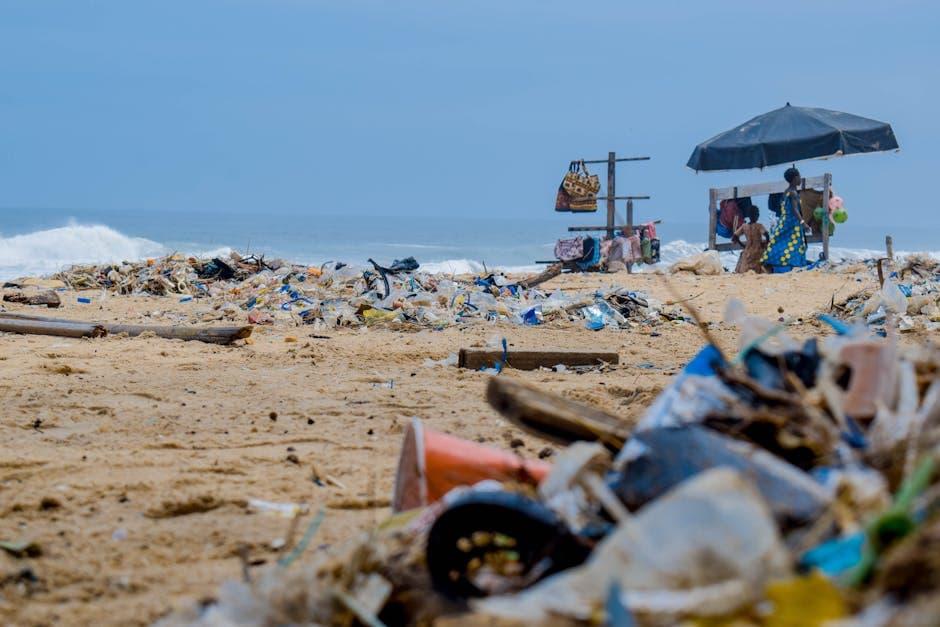
11. An estimated 100,000 marine mammals die from plastic pollution every year.
The Marine Mammal Commission and multiple peer-reviewed assessments attribute roughly 100,000 marine mammal deaths annually to entanglement in and ingestion of plastic debris. Seals, dolphins, and whales are among the most affected species, with abandoned fishing nets posing the greatest entanglement risk.
12. Approximately 1 million seabirds are killed by plastic each year.
UNESCO cites this widely referenced estimate, first derived from studies tracking albatross, petrel, and shearwater populations. Seabirds mistake floating plastic fragments for food and feed them to their chicks, leading to starvation, internal injury, and toxic chemical exposure.
13. Over a third of fish sampled in scientific studies contain microplastics.
A meta-analysis of global fish sampling studies found that 36.5% of fish contained microplastic particles in their digestive systems. This contamination rate was consistent across species and ocean regions, covering both commercial fisheries and deep-sea populations.
14. More than 700 marine species have been documented interacting with plastic debris.
The Convention on Biological Diversity reports that over 700 species — including fish, seabirds, marine mammals, and sea turtles — are affected by plastic through ingestion or entanglement. That number has risen steadily as more species are studied.
15. More than half of all sea turtles have ingested plastic.
Schuyler et al. (2015), published in Conservation Biology, found that 52% of sea turtles worldwide have eaten plastic debris. All seven sea turtle species are affected. Turtles frequently mistake plastic bags for jellyfish, one of their primary food sources, and even small amounts of ingested plastic significantly increase mortality risk.
Our full guide on how plastic affects marine life covers these impacts and their cascading effects through ocean food webs.
How Does Ocean Plastic Affect Human Health?
The contamination cycle does not end with marine animals. Microplastics have entered the human food chain and are now found inside our bodies.
16. Microplastics have been detected in human blood, lungs, and placental tissue.
A 2022 study by Vrije Universiteit Amsterdam, published in Environment International, was the first to detect microplastics in human blood — finding plastic particles in 77% of test subjects. Separate studies have confirmed microplastics in human lung tissue (Jenner et al., 2022, Science of the Total Environment) and in human placenta (Ragusa et al., 2021, Environment International).
17. The average person may ingest approximately 5 grams of plastic per week.
A 2019 study commissioned by WWF and conducted by the University of Newcastle estimated that people consume up to 5 grams of microplastic weekly — roughly the weight of a credit card. Sources include drinking water, seafood, salt, beer, and airborne particles. More recent studies suggest actual intake may vary, but the finding illustrates the pervasiveness of microplastic contamination.
18. Seafood is a primary pathway for human microplastic exposure.
Shellfish and small fish consumed whole are the highest-risk seafood categories, because their entire digestive tracts are eaten. A 2020 review in Environmental Health Perspectives found that mussels, oysters, and shrimp contain some of the highest microplastic concentrations among commonly consumed species. Populations with high seafood diets face proportionally greater exposure.
19. Plastic debris leaches harmful chemicals including BPA, phthalates, and persistent organic pollutants.
The WHO's 2022 report on microplastics in drinking water noted that plastics can carry or release endocrine-disrupting chemicals such as bisphenol A (BPA) and phthalates. Ocean plastics also absorb hydrophobic pollutants like PCBs and DDT from surrounding seawater, concentrating them at levels up to 1 million times higher than ambient water (Teuten et al., Environmental Pollution).
20. Approximately 4.8 to 12.7 million tonnes of plastic entered the ocean annually when the foundational human health research was being conducted.
The landmark Jambeck et al. (2015) study in Science established this range, which has been the baseline for most subsequent health risk assessments. Since then, production has increased and waste management infrastructure in high-leakage countries has not kept pace, meaning actual ocean inputs — and therefore human exposure pathways — have likely grown.
What Is Being Done to Stop Ocean Plastic?
The facts above paint a bleak picture, but they do not tell the whole story. Measurable progress is happening in policy, prevention, and community-based collection.
21. The UN Global Plastics Treaty negotiations are the most ambitious international effort to date.
The Intergovernmental Negotiating Committee (INC) has been working toward a legally binding global agreement to end plastic pollution. INC-5 negotiations took place in Busan, South Korea in late 2024, with continued sessions in 2025. The treaty could establish binding production caps, phase out problematic plastic types, and create mandatory EPR frameworks, though disagreements between petrochemical-producing and waste-importing nations have slowed consensus.
22. Community-based collection programmes are intercepting billions of plastic items before they reach waterways.
Prevention is consistently more cost-effective than ocean cleanup. Plastic Bank has collected 9.4 billion bottles across the Philippines, Indonesia, Brazil, Egypt, and Thailand by paying coastal community members to intercept plastic before it reaches waterways. Each kilogram collected is tracked through blockchain verification, and the resulting Social Plastic® feedstock enters certified recycling streams. The programme's live tracker shows real-time collection data.
23. Prevention is estimated to cost 10 to 20 times less than ocean cleanup per tonne of plastic removed.
According to a 2020 report by the Pew Charitable Trusts and SYSTEMIQ, upstream interventions — including waste collection, recycling infrastructure, and production reduction — are dramatically cheaper than post-entry cleanup technologies. The report modelled that a comprehensive prevention strategy could reduce ocean plastic flows by 80% by 2040.
24. Extended Producer Responsibility (EPR) laws are spreading globally.
EPR shifts the cost of plastic waste management from municipalities to the companies that produce plastic packaging. As of 2025, EPR frameworks exist in the European Union, India, Canada, and several ASEAN nations. The Philippines enacted its EPR Act (Republic Act No. 11898) in 2022, requiring large importers and manufacturers to recover a percentage of their plastic packaging from the waste stream.
25. The OECD projects plastic waste generation will nearly triple by 2060 without policy intervention.
The OECD's Global Plastics Outlook (2022) projected that without aggressive new policies, global plastic waste generation would rise from 353 million tonnes in 2019 to 1,014 million tonnes by 2060. Plastic leakage into aquatic environments would double. The report is the most comprehensive economic modelling of plastic pollution pathways published to date.
Frequently Asked Questions
How bad is ocean pollution?
Ocean pollution has reached every marine environment on Earth — from equatorial coral reefs to Arctic sea ice to the Mariana Trench at 10,000+ metres depth. Between 19 and 23 million tonnes of plastic waste enter aquatic ecosystems annually, joining an estimated 82 to 358 trillion particles already on the surface. Over 100,000 marine mammals die each year from ingestion or entanglement, and 90% of seabird species have been found with plastic in their digestive tracts. Microplastics have entered the human food chain through seafood, drinking water, and airborne particles, with documented presence in human blood, lungs, and placental tissue.
What is the biggest source of ocean pollution?
Plastic waste is the dominant category, comprising roughly 80% of all marine debris. Land-based sources account for about 80% of ocean plastic, with rivers serving as the primary transport corridor. Research by Meijer et al. (2021) identified over 1,000 rivers responsible for the majority of river-to-ocean plastic transfer, concentrated in Southeast Asia, South Asia, and West Africa. Maritime sources — abandoned fishing gear, cargo losses, vessel waste — account for the remaining 20%. Beyond plastic, other significant ocean pollutants include agricultural runoff (nutrient loading causing dead zones), industrial discharge, and oil spills, though plastic is the most persistent and widespread.
How does ocean pollution affect humans?
The primary exposure pathway is through seafood. Research published in Frontiers in Marine Science (2025) found microplastics in 36.5% of fish caught for human consumption. Microplastics absorb persistent organic pollutants from seawater and transfer these concentrated toxins to organisms — and ultimately to human consumers. A 2024 study in the New England Journal of Medicine found that patients with microplastics in carotid artery plaque had a 4.5 times higher risk of cardiovascular events. Microplastics have also been detected in human blood, lung tissue, and placental samples, though the long-term health consequences are still being studied.
What percentage of ocean pollution is plastic?
Plastic accounts for approximately 80% of all marine debris by item count and volume. It is the most persistent category of ocean pollution — a plastic bottle takes roughly 450 years to decompose, and styrofoam persists indefinitely. Other contributors include glass, metal, rubber, textiles, and paper/cardboard, but these materials either decompose faster or sink to the seafloor relatively quickly. Plastic's buoyancy, durability, and tendency to fragment into microplastics make it uniquely damaging and widespread in marine environments.
Can ocean pollution be reversed?
Existing microplastic contamination in deep-sea sediments and the water column cannot be practically removed with current technology. However, the rate of new pollution can be dramatically reduced. The OECD's Global Plastics Outlook models show that under ambitious policy scenarios — combining production caps, universal waste collection, EPR legislation, and scaled prevention programmes — ocean plastic leakage could be cut by over 90%. Organisations like Plastic Bank demonstrate that community-based collection can intercept billions of items before they reach the ocean. The scientific consensus is clear: the problem is solvable if proven solutions are funded and deployed at scale.
Why These Facts Matter
Ocean pollution statistics can feel numbing at scale. The numbers risk becoming abstract at this scale. But each figure in this list represents a measurable, documented reality. Peer-reviewed studies sit behind every claim. And critically, the trajectory of every trend listed here is upward. Production is rising. Contamination is spreading to more remote environments. Health research is uncovering new exposure pathways.
The facts also point to where solutions work. Community-based prevention programmes are diverting billions of items. EPR legislation is shifting financial responsibility to producers. International treaty negotiations, despite their slow pace, represent the first serious attempt at binding global rules.
The gap between what the science tells us and what policymakers have acted on remains wide. These 25 facts are a snapshot of that gap, and a starting point for closing it.
For the full picture on ocean plastic, read our comprehensive guide to plastic pollution in the ocean and our coverage of the Great Pacific Garbage Patch.